
Settling in Canada: What Comes After Immigrating
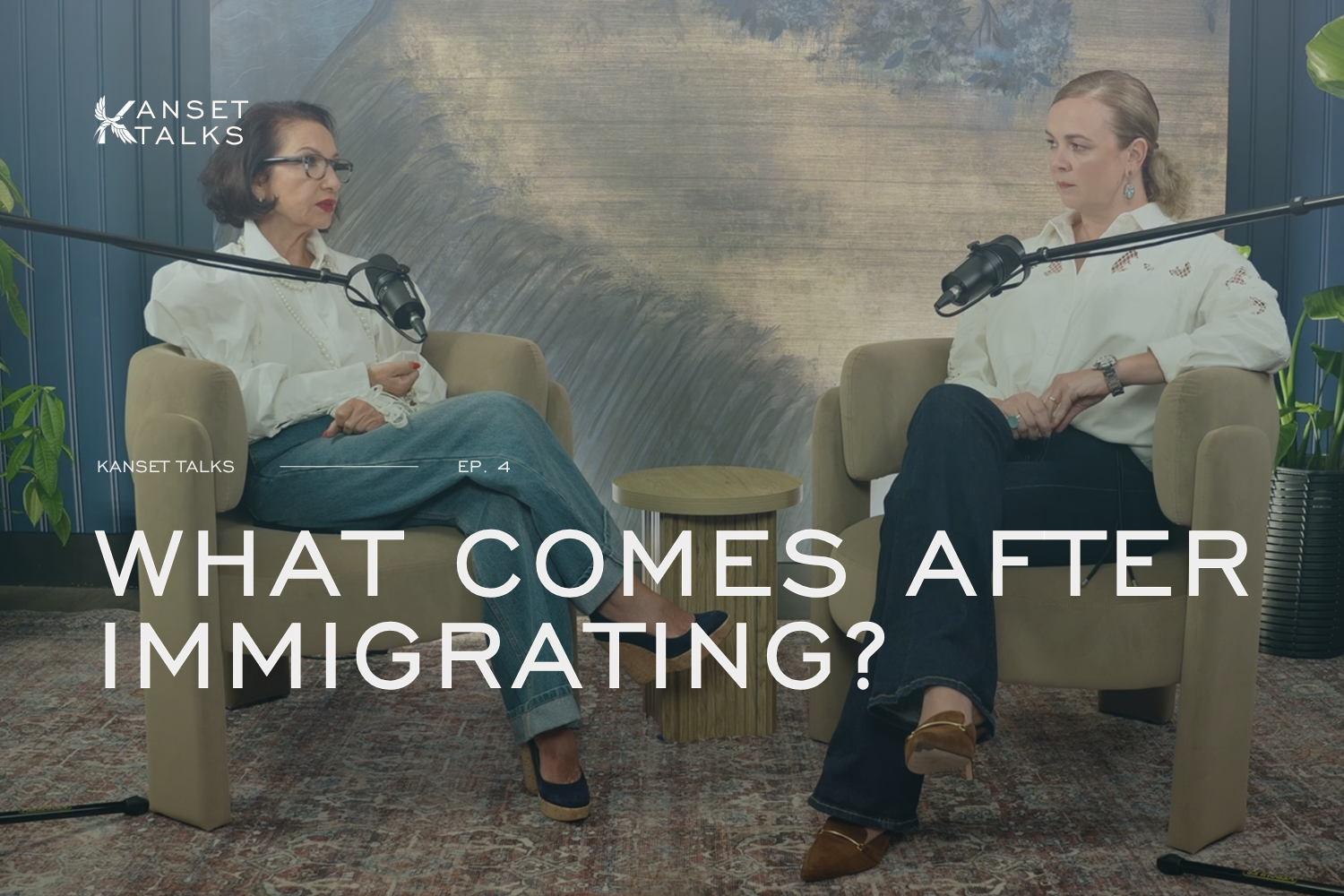
For newcomers, receiving permanent residence can feel like the finish line. In practice, much of the harder work has only begun: finding a home, rebuilding a career, creating a community and learning how to adjust. In Episode 4 of Kanset Talks, Maria Guerts and Mary Nirenberg talk about what happens after becoming a permanent resident.
Where to rent our first apartment? Do we need insurance? What kind? Can we get a mortgage? Can my child apply for OSAP?
Mary Nirenberg hears questions like these at an immigration office often enough that they have become part of the work.
They usually come after something important has already happened. A client has received a work permit or permanent residence. The application that consumed months, sometimes years, is finally resolved. And then, just when people expected to finally exhale, a different kind of uncertainty begins.
Mary, the president of Kanset, has a metaphor for it. A newcomer, she says in the fourth episode of Kanset Talks, is a little like a newborn. At first, the baby trusts its mother and depends on her for everything, “starting with diapers and shoes and walkers and everything that that child needs to grow up.”
The comparison is deliberately broad. Immigration professionals are not mortgage brokers, employment counsellors or real estate agents. But trust tends not to observe professional boundaries quite so neatly. If someone has guided a family through the Canadian immigration system, that person may also become the obvious first call when the family needs to know whom else they can trust.
Maria Guerts, Kanset’s licensed Canadian immigration consultant, lays the question in another way.
Everyone talks about how to immigrate, she says. Far less attention is paid to what happens once you actually do.
“But settlement is just as important. What comes after immigrating? What comes after getting that PR, that work permit in your hands?”
That question runs through their conversation, but it also points to something larger about immigration to Canada today. The legal process and the process of building a life here are not sequential. Increasingly, they overlap for years.
Immigration gets you here. Settlement determines what happens next.
For Kanset, the result of being the go-to for all things professional services is becoming a kind of community hub. Clients return for trusted recommendations: a lawyer, a mortgage broker, a real estate agent, or perhaps another professional who can solve a problem that has nothing to do with immigration law.
Mary is careful about giving those recommendations.
Maria says Mary puts more effort into this venture than anyone else she knows, because she takes it a step further and follows up on her referrals: How did it work out for you?
“When I mention somebody’s name, I would like to say it’s from my own personal experience,” Mary says.
After 50 years in Canada, she has accumulated the sort of network that is difficult to reproduce through a Google search. But even then, she says, a recommendation is not simply a matter of identifying the most qualified person. Sometimes she has two or three people she could recommend. It’s all about the fit.
“Personalities need to match and a way of doing business needs to match.”
If you have just arrived, that difference matters. So much of settling in is learning things everyone around you seems to know already: where to rent, how to borrow, where to look for work, when insurance is needed, who to call when something goes wrong. A name you can trust takes one thing off a list that is long enough already.
The hardest part of immigration may begin after arrival
And the practical unknowns may be the easier part.
Both women came to Canada as children. Mary was 10; Maria was 15. Maria counts herself lucky: “I feel very lucky that my parents had to go through the trouble of immigration.” Looking back, Mary thinks their ages worked in their favour.
“It’s always easier for children because they’re very adaptable and very flexible,” she says. “It’s the parents who need guidance.”
Adults arrive carrying considerably more with them, even when the suitcases look the same.
A child enters school and begins accumulating a new life almost automatically. An adult may have left behind a profession, a reputation, friendships, routines and the quiet confidence of knowing how things work. Here, all of that has to be learned again.
“The adults who immigrate to Canada feel lonely and isolated at first,” Mary says.
Even an existing network does not always solve the problem. Relatives have their own lives. Friends who promised to help may be busy. Some relationships, Mary observes, simply do not survive the transition from one country to another.
The uncomfortable part is that permanent residence does not always cure the feeling. Nor, always, does citizenship. If you have your status and still wonder some evenings whether you made the right call, you are far from the only one, and it is not, on its own, a sign that you chose wrong.
At home, Mary says, people may have had “a certain way of life” and a position in society. Here, they may have to begin again.
Maria sees one small but meaningful difference among newcomers. Parents of school-age children often acquire a community almost by accident. There are schools, sports, lessons, birthday parties and other parents. “Everybody’s an immigrant,” she says of the circles around her own children’s activities.
Someone arriving alone, or a couple without children, may have no ready-made circle like that. Then settling in means building one on purpose: the coffee with a colleague, the neighbour you say yes to.
“This is where we come in,” Maria says. “We’re always there to help.”
Mary knows something about abrupt beginnings herself. Her family arrived in Canada as four people with $500, and both parents were working in factories within two weeks. She tells that story in the episode, and it is one of the places where hearing her tell it is better than reducing it to a paragraph. What she kept from that beginning is not something she wants to lose. “I think it’s romantic to have an accent,” she says. “Just means, you know, at least one more language.”
Canada offers free settlement services, but not to everyone
There is, of course, an institutional version of settlement too.
The federal government funds free newcomer services through organizations across Canada outside Quebec. Depending on eligibility, newcomers can get help looking for work, improving their English or French, navigating professional licensing and connecting with their communities.
But there is an important gap between the ordinary meaning of “newcomer” and the government’s eligibility rules.
Permanent residents generally qualify for federally funded settlement services, as do certain people approved in principle for permanent residence. Most temporary foreign workers do not, apart from limited exceptions.
And since April 1, 2026, economic-class permanent residents also face a clock. Those who became permanent residents under economic programs can generally access federally funded settlement services for up to six years from the date they became PRs. For people who become permanent residents on or after April 1, 2027, that period falls to five years. Citizenship ends eligibility.
That means someone who has lived in Canada for several years without ever thinking of themselves as needing “settlement services” may discover that useful support was available all along, but not indefinitely.
The first Canadian job is often an identity problem as much as an employment problem
Work, unsurprisingly, is where the practical and psychological sides of settlement most often collide.
Maria describes the anxiety underneath it very simply: people need to know where the next paycheque is coming from.
The sensible response begins before the first interview. What does the Canadian labour market actually look like in your profession? Is the occupation regulated? How much of your experience will transfer? And if the exact job you had before is not immediately available, what is close enough to become a starting point?
That last question can be difficult.
Mary has watched doctors, engineers, lawyers, professors and other highly trained newcomers arrive with identities built partly around their professions. Then Canada asks them, at least temporarily, to imagine themselves differently.
Her answer is to look beneath the title.
An engineer may not be able to begin immediately as an engineer, but could work as a technologist or supervise people working in the same field. The expertise has not disappeared simply because the Canadian job title has changed.
“You don’t have to be an engineer straight away,” she says.
There is a familiar Canadian immigration narrative in which foreign credentials are ignored and every newcomer spends years painfully climbing back toward a career they already had. Maria complicates that picture.
She increasingly sees clients who call a year or two after arrival with a promotion, a new title or a substantially higher salary. In some professions, she says, overseas experience is recognized quickly.
The point is not that either story is the correct one. Canada’s labour market does not receive every newcomer, or every profession, in the same way. The first Canadian job can be a major step backwards, a lateral move, or the beginning of surprisingly rapid advancement.
Mary is less interested in predicting which one it will be than in how people respond to the uncertainty.
The newcomers she admires, she says, are the ones who “will not let their ego get in the way,” and who “chisel out a new person out of themselves. Somebody that has always been inside of themselves but has never had to come out.”
At one point in the podcast, she illustrates this with a story involving a chef, a job interview and an apple. Like her arrival story, it works because Mary tells it as a story, not because it can be converted neatly into advice.
Settlement and immigration planning are becoming harder to separate
There is another reason the distinction between “immigration” and “settlement” has become harder to maintain.
For years, Maria says, many clients could imagine a fairly understandable progression. Find an employer. Obtain a work permit. Accumulate a year of qualifying Canadian work experience. Move toward permanent residence through the Canadian Experience Class.
“That was the formula and it worked for so many.”
A relationship with an immigration firm might last a year, perhaps two or three.
“That’s not the reality today.”
The programs still exist. What has changed is the degree of certainty around the route.
Canada reduced its permanent resident targets in 2024, and the current immigration levels plan sets permanent resident admissions at 380,000 annually from 2026 through 2028. Maria points to quotas, and to what Express Entry has become, as reasons people now look for other pathways.
For an individual worker, the result may be a much longer period between arriving in Canada and becoming a permanent resident.
That extra time is not spent in suspension. People are working, changing jobs, having children, moving cities, signing leases and building careers while their immigration strategy continues to evolve in the background.
Employers can become part of that prolonged process too.
Where a worker's status depends on a Labour Market Impact Assessment, or LMIA, extending the arrangement is not simply a matter of proving that the foreign worker has performed well.
“Just because you’re extending a foreign worker’s work permit doesn’t mean you’re doing great,” Maria says.
An employer may again need to demonstrate that it has made genuine efforts to recruit Canadians and permanent residents. For high-wage LMIA positions, employers are generally required to have a transition plan describing how they will recruit, retain and train Canadians and permanent residents and reduce their reliance on the Temporary Foreign Worker Program. A later application for the same job and location can require the employer to account for what it did under the previous plan.
A worker, then, may be settling in well while the paperwork underneath that life is still temporary.
Build the life first. Let the immigration strategy adapt.
This is where the conversation between Mary and Maria arrives at perhaps its most useful idea.
Immigration clients naturally want a plan. They want to know which program will lead to permanent residence and what sequence of decisions will get them there.
But a plan designed in year one may no longer make sense in year three.
Programs change. Draws change. Eligibility rules change. Governments alter priorities. A person changes too.
Some Kanset clients, Mary says, eventually find that they no longer qualify for the permanent residence pathway they originally chose together.
If that happens to you, it is easy to feel that your life has gone off course.
Mary suggests almost the opposite.
“Don’t chase the rules,” she says. “You build your life, you start your life, you go along your professional path, you settle once you’re here on a work permit, and we will adjust the plan according to what the changes will be, because the changes are happening daily.”
There is a quiet reversal in that advice.
Immigration encourages people to think in milestones: permit, experience, application, permanent residence, citizenship. Settlement happens in a different kind of time.
The apartment is already home before the PR card arrives. The temporary job may turn into a career. The children acquire friends and accents. The unfamiliar grocery store becomes the usual grocery store. A collection of practical decisions slowly becomes a life.
The immigration plan has to keep catching up with it.
It is the same instinct behind something Mary says about newcomers more broadly: “Let them be Canadians, we’re gonna be proud of them.”
Mary has now lived in Canada for half a century. When people ask about her country of origin, she says, the answer that feels natural is no longer the one they may expect.
“I will say Canada, because this is how I feel.”
Near the end of the episode, Maria and Mary turn to another subject that increasingly intersects with Canadian immigration planning: French, introduced as “the F word,” before the conversation moves into why language can change not only someone’s experience of Canada, but their immigration options.
It is a fitting place for the article to stop and the conversation to continue.
Watch Episode 4 of Kanset Talks for Mary and Maria’s full conversation, including Mary’s arrival story, the chef and the apple, and what they have to say about French, changing immigration pathways and building a life in Canada before permanent residence arrives.
If your immigration plan has changed, or you are already in Canada and not sure who to call first, you do not have to sort it out alone. Book a consultation with Kanset.
Official sources
The general information on this page comes from the Government of Canada. To read the rules yourself:
Eligibility for newcomer services, including the time limit for economic class PRs (canada.ca)
The 2025 to 2027 Immigration Levels Plan announcement (canada.ca)
2025 Annual Report to Parliament on Immigration, with the 2026 to 2028 Levels Plan (canada.ca)
What is a Labour Market Impact Assessment? (IRCC Help Centre)
LMIA program requirements for high-wage positions, including the transition plan (canada.ca)
This article is general information only and is not legal advice. Immigration rules can change, and every case turns on its own facts.