
Why a Standard Immigration Document Checklist Is Not Enough
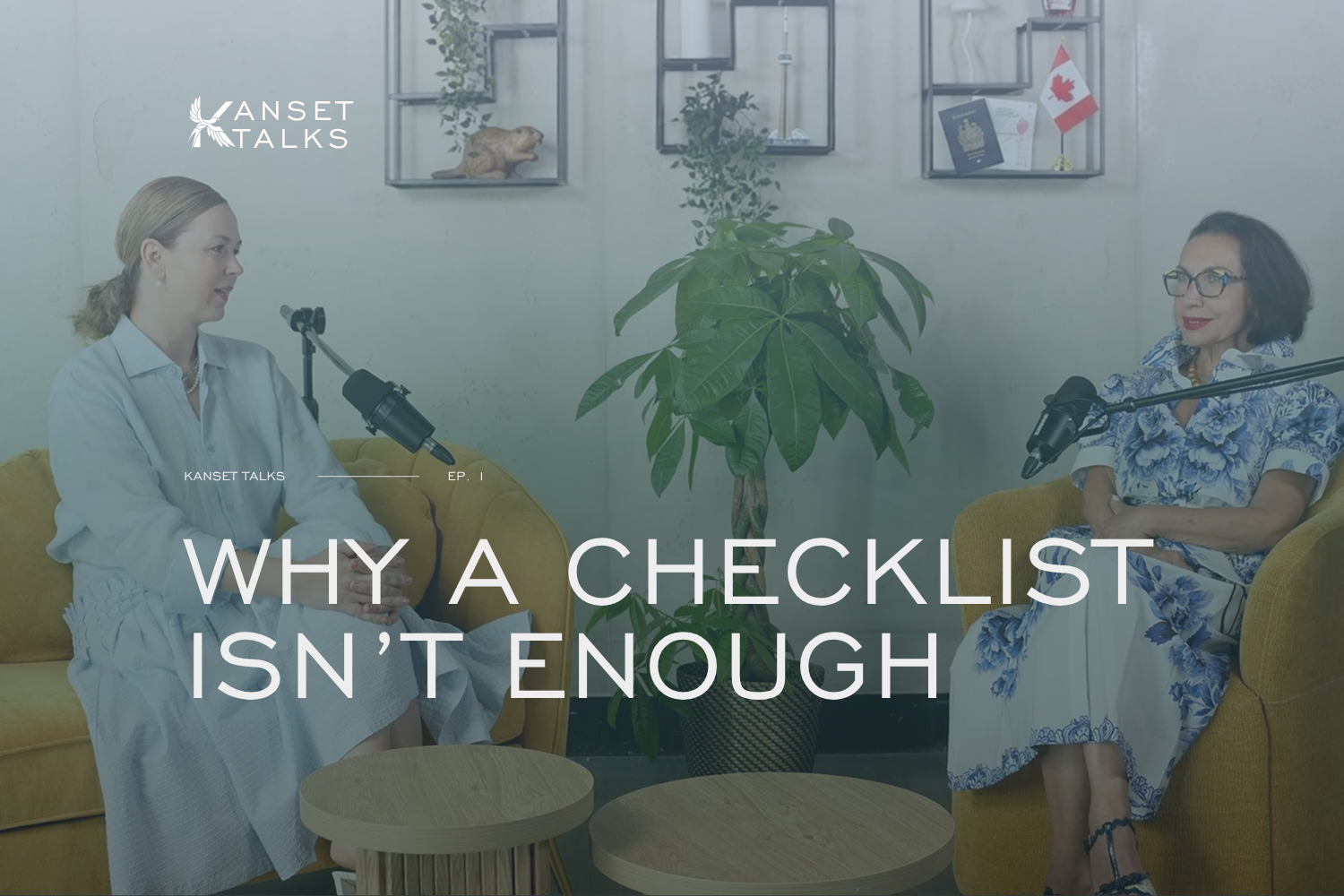
Some partnerships predate the firms they build. Maria Guerts and Mary Nirenberg met 19 years ago at a large immigration law firm, long before Kanset existed, and they have not worked apart since. The first episode of Kanset Talks opens on how that began, a job interview and a red suit included, though that part of the story is better watched than retold here.
Across the episode the two partners move briskly through the questions clients actually ask: how to prove a marriage is real, who still needs a language test for citizenship, why a study permit is not always the right route, whether you can travel while a file is open. The answers are short, but each carries the kind of judgment that only years of difficult cases teach. What the conversation keeps returning to is the thread beneath all of them: there is no standard immigration document checklist that carries an application on its own.
Kanset Talks episode 1, Maria Guerts and Mary Nirenberg on the strategy behind a strong immigration application.
Why a standard immigration document checklist is not enough
Ask most applicants what they need, and they describe a list. Attach this form. Add that proof. Upload the rest. Submit. The list is real, and it matters. It is also only the floor.
An officer does not approve a file because every box has something in it. The officer has to be satisfied, that the information is accurate, that the pieces agree with one another, and that the evidence actually supports the story on the page. Two people can apply under the same program and need completely different documents to get there. One has a clean history. The other has an old refusal, a gap nobody explained, a travel record that raises a question. The stronger application is the one that answers those questions before an officer has to ask them.
How do you prove a genuine relationship in a spousal sponsorship?
Maria tells the story of a client who was almost insulted by the question. He was sponsoring his wife. They had three children together. To him, that was the end of the discussion.
She had to show him how an officer reads the same facts. Three children prove the couple was together at some point. On their own, they do not prove where the relationship stands now, and "now" is what a sponsorship has to establish. The answer is not to stage anything. It is the opposite. A marriage is real whether the couple honeymooned at Niagara Falls or grabs coffee at Tim Hortons, and the work is to show that ordinary, real life plainly, and to explain anything unusual before it hardens into a doubt. That judgment is what a family sponsorship file turns on.
Do you need a language test for citizenship after 54?
It comes down to your age on the day you sign the application. Adults 18 to 54 have to show they can speak and listen in English or French at Canadian Language Benchmark level 4 or higher, and they have to take the citizenship test. Applicants 55 and older are exempt from both.
The trap is in the word "proof." People assume that sitting through a language course settles the requirement. Sometimes a course certificate does count, but only a particular kind, one that shows speaking and listening at CLB 4 or higher. Attendance alone is not the same thing. And Maria flags something the paperwork can hide: even with an accepted document on file, an officer can still choose to assess an applicant's language in person, and sometimes does. She would rather raise that with a client at the start than have it surface at the interview.
What happens if your immigration application is incomplete?
It comes back. IRCC returns an incomplete application with a letter and a checklist naming what was missing, and the clock resets. Sometimes months have gone by, and the applicant's own life has changed in the meantime.
What stings is how ordinary the causes are. A missing signature. An outdated form. A document that belonged in the package from the start. A complete application is not a thick file, it is a consistent one, where the forms, the dates, the facts, and the evidence all tell the same story. Before anything goes in, it helps to read it the way an officer will, and ask one question: could a stranger follow this without guessing?
Should you tell IRCC if your situation changes while your application is in process?
Yes, and earlier than feels necessary. A marriage, a divorce, a new baby, a death in the family: if your personal situation changes while a file is being processed, it may need to be reported to IRCC, because the application is judged on your facts, and the facts have moved.
Disclosing a change rarely hurts a file. Hiding one does. Mary puts it more bluntly: it always comes out, so be the one who told them. When something shifts mid-process, tell your representative first and let them decide what goes to the government, and how.
Can you travel while your application is being processed?
There is no single answer, which is why the question comes up so often. It turns on the type of application, on your status in Canada right now, and on whether you applied from inside the country or outside it. Maintained status, an appointment you still have to attend, your ability to get back in: any of these can change the answer.
For some applicants a trip is fine. For others it puts status or timing at risk. Refugee and protected-person cases are the most sensitive of all, especially any travel connected to the country a claim rests on. This is not a checklist question. It is one to reason through against your particular file.
Are you applying for a study permit, or planning a life in Canada?
A man in his forties once came to Maria for help with a study permit. He held a master's in engineering, and he wanted to study hotel management. She stopped and asked him why. Was hospitality the dream, or was the real goal to work here, bring his family, and stay?
It was the second one. Once that was on the table, the sensible route looked nothing like the study permit he had walked in asking for. Mary reduces the lesson to a line she repeats to clients: do not chase the rules, because the rules change. Start from the goal, and choose the path that fits it. A program of study should line up with your background, your budget, and where you actually want to end up, not with a rumor that it helps with immigration later. A study or work permit should serve the life you are building, not the other way around.
What this means in practice
An application is not a pile of forms. It is an argument, made in documents, that a real person meets a real requirement. The checklist tells you what the government wants to see. Strategy is everything the checklist cannot: dates that match across every form, evidence that reflects an actual life, a plain explanation for anything that looks odd, and a route chosen to fit the goal rather than the other way around.
That is why the first meeting carries so much weight at Kanset. Before anyone names a program, the work is to understand the person, the history, the risk, and the goal underneath the request, then to build the file around all of it.
If you want to know what your own situation calls for, book a consultation with Kanset.
Official sources
The general information on this page comes from the Government of Canada. To read the rules yourself:
Citizenship language requirement (canada.ca)
The citizenship test (canada.ca)
Who can apply for citizenship, including the age exemptions (canada.ca)
Which documents prove the language requirement (IRCC Help Centre)
If an application is returned as incomplete (IRCC Help Centre)
Reporting a change in your situation (IRCC web form)
This article is general information only and is not legal advice. Immigration rules can change, and every case turns on its own facts.